Friday, December 17, 2010

I have ranked the top 68 television shows of the '00s, and will be presenting them, one-by-one, starting with 68 and working down. The rankings are more or less based on the show's popularity, it's cult status, it's critical acclaim, and my personal liking of it, with a heavy dose of arbitrariness added in. If a show was a big enough phenomena, I'll keep it on the list - but if I don't like it, I may drop it some spots. One other caveat - these are primetime shows (I apologize if I put a cable show that wasn't, I thought they were all primetime shows - the main point of this is just that no talk shows, no Colbert and Daily show that would be on otherwise).

21. Curb Your Enthusiasm


HBO shows are popping up all over this list, and HBO's signature comedy (well one of two - this and Sex and the City - but this is more of a comedy with a capital C - it's about the laughs and nothing but) is one of those shows that is all about the laughs (see earlier parenthesis) - like It's Always Sunny in Philadelphia, it's not interested in you really investing in the characters, or feeling any pathos in the story or plot. It's essentially Seinfeld in Los Angeles, but without the straight man to point out how absolutely insane either Larry is being, saying what the viewer is thinking (Larry's wife, Sheryl, sort of gets that role to an extent, surely but her role is so thoroughly dominated by Larry, where Jerry's is at the least equal to the rest of the Seinfeld characters). It's slightly inferior to Seinfeld because of this, but it's mostly more of the same, and gets the laughs that a show like that needs to succeed (Entourage, ostensibly a comedy isn't very funny but makes up for it with a serial more or less interesting plot).


An interesting game (if one can call it that) I play when watching episodes is trying to pick in each situation that comes up whether Larry is right and everyone else is insane (example: the rule of the dry cleaners - in one episode, Larry loses his jersey in the dry cleaner's - another customer gets it by accident - and everyone (including guest star Senator Barbara Boxer) claims it's part of the great rule of the dry cleaner's - sometimes you win, sometimes you lose) or Larry is wrong (example: Larry gets into a fight with a bunch of children when he pays them for some lemonade and then tries to demand his money back when the lemonade stinks). It's honestly about half and half.

Praise should certainly be generously given to the supporting characters - Jeff Garland as Larry's agent is great, as well as numerous recurring guests such as Richard Lewis and Ted Dansen (part of the great Ted Dansen revival along with Damages and Bored to Death, a topic for another day), but the show is really about Larry himself (some people absolutely love Susie Essman as Jeff's wife who curses constantly and kicks Larry out of her house almost every other episode for some reason, but she, for the most part, doesn't do it for me - it's just too much, even by Curb standards). Larry has his share of catchphrases - "prett-ay good" (you really have to hear it to understand how he says it, "Let me ask you something" generally preceding a particularly inane question, and his long-form stare (go to 42 seconds for the stare, and keep watching to hear the "prett-ay good.").

The guest stars are too numerous to name and each season has a loose plotline, the best of which may be the seventh season in which Larry arranges a Seinfeld reunion, all as a ploy to get his ex-wife back, which allows the possibility of having a Seinfeld reunion, without ever having to have one officially (George struck it rich with the iToilet - a mobile phone application letting you know where the nearest free toilet was, but lost all his money to Bernie Madoff).

I would be remiss to mention the strangest random fact about Curb Your Enthusiasm which is incidental to the show itself, but fascinating - a man was cleared of a murder charge because he was caught in the outtakes for a Curb Your Enthusiasm episode (the one where Larry picks up a prostitute to take the HOV lane to the game) at Dodger Stadium. So Curb has contributed to society.

It took me way to long to watch this show for someone who loves Seinfeld, and yes, it's not going to blow your mind - it's exactly what you expect, but it's funny, and you can't ask that much more from something.

Thursday, December 16, 2010

I have ranked the top 68 television shows of the '00s, and will be presenting them, one-by-one, starting with 68 and working down. The rankings are more or less based on the show's popularity, it's cult status, it's critical acclaim, and my personal liking of it, with a heavy dose of arbitrariness added in. If a show was a big enough phenomena, I'll keep it on the list - but if I don't like it, I may drop it some spots. One other caveat - these are primetime shows (I apologize if I put a cable show that wasn't, I thought they were all primetime shows - the main point of this is just that no talk shows, no Colbert and Daily show that would be on otherwise).

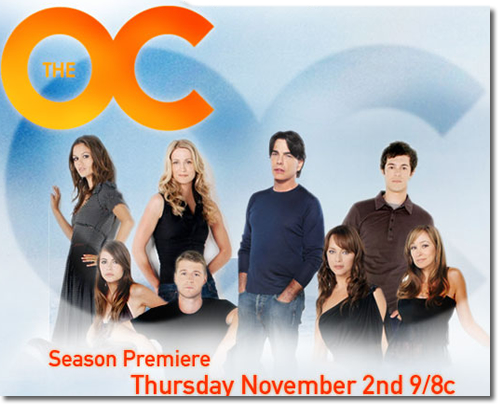
22: The OC


Here's one of the great Moment shows. We've had a few so far - Heroes comes to mind - and I know there's at least another if not more coming - but this is one of those shows that had the equivalent of music's first album syndrome (I'm looking at you, Strokes) - it came out and set the world on fire - it was the absolute hottest show for a short period of time but just found it impossible to maintain its level of success and petered out way faster than you would guess by the way the show came out of the gate (this is in parallel to say the Everybody Loves Raymond, White Stripes strategy - no one watches you first season, listens to your first album, but the right people have faith, and you have room to build).

The O.C. came out in 2003 as one of those soaps that are smart and cool, trend-setters like (unsurprisingly, Josh Schwartz, the creator later went on to create Gossip Girl - which fits pretty much the exact same description). The show performed the rare feat of gaining viewers week to week at the beginning of its run - a sure sign of a hit - and was the highest rated network drama its first year among viewers 18-24, and although that sounds needlessly specific and thus less impressive, it's kind of a big deal. It did a couple of things that are peripheral signs of a hit in the making - it made at least relative stars of some of its cast members - Misha Barton probably most of all, but also somewhat of Adam Brody and Rachel Bilson. Seth Cohen, Adam Brody's character - the lovable nerd and bringer of all things pop culture to the show's universe - (Death Cab for Cutie, his favorite band is featured prominently) came up with with the buzzwordy holiday of Chrismukkah (yes it has its own wikipedia page, albeit it's only the second most popular fake Christmas holiday after Seinfeld's Festivus). It featured music prominently and sent sales by artists appearing on the show skyrocketing - Rooney's sales doubled immediately after their appearance, and most impressively, Imogen Heap's Hide and Seek became an instant classic after appearing in the Season 2 finale.

The show absolutely fell apart by the fourth season, and some people I know who watch it religiously have said, more or less by the third, and maybe was on an inevitable path down from the beginning of the second. Generally, the third season is regarded as the worst, and the fourth a bit of a step up, but it was too little too late by that part - bad ratings coupled perhaps with the shocking death of Marisa Cooper (Barton) had the show all but over somewhere through the middle of the fourth season (One of the only episodes I've seen is that death episode - I was so confused if she was really dead as it seemed like a big fucking deal to kill off a main character). It would be also unfair to leave out that the show falls into the classic graduating from high school trap - very few shows can make the leap from high school to college or whatever else successfully.

It's the sad reality in a way - it's just hard to keep up with that first burst, and what a burst it was - in college, the OC was everywhere.

Monday, December 13, 2010

I have ranked the top 68 television shows of the '00s, and will be presenting them, one-by-one, starting with 68 and working down. The rankings are more or less based on the show's popularity, it's cult status, it's critical acclaim, and my personal liking of it, with a heavy dose of arbitrariness added in. If a show was a big enough phenomena, I'll keep it on the list - but if I don't like it, I may drop it some spots. One other caveat - these are primetime shows (I apologize if I put a cable show that wasn't, I thought they were all primetime shows - the main point of this is just that no talk shows, no Colbert and Daily show that would be on otherwise).

23: Two and a Half Men


Oh, Two and a Half Men. TV's biggest comedy has been running now for an unbelievable 8 years and shows no signs of slowing down (Yes - shouldn't it now be called 3 men? Phew, needed to get that joke out of the way). Charlie Sheen might be regarded as something of a genius and an argument for TV over movies - who needs film when he makes 1.78 million an episode - about 40 million a year, and pretty much a guarantee of not flopping.

My friends and I have a minor inside joke that went on for a while where we were going to start a blog called the 2.5ers and dissect every Two and a Half Men episode joke by joke explaining how each one is funny and consequently why the show is so great. It could have been a thing.

You probably know the premise, they're not all that much to it. Recently divorced fairly pathetic man (Emmy award winner Jon Cryer) moves in, along with his son, to his ladies' man brother's (Sheen, of course) swank Malibu house. Honestly, there's a whole lot more characters than I realized - I've seen a couple of episodes, but there's eight seasons worth - and I'm sure loads of backstory and loves gained and lost, but really what it is, love it or hate it, is the standard bearer for Classic American Sitcom on TV right now (Big Bang Theory might be making a push sadly but it's still a ways away).

What I didn't know is that apparently there was a CSI/Two and a Half Men crossover which sounds absolutely insane - in the Two and a Half Men part of the crossover apparently a man is found dead, assumed to be murdered, but actually was a con artists and died of a heart attack (sure that's a super incomplete description of the episode - but be honest - do you really care? And if you do, and you haven't seen it, I'm sorry I ruined it for you.)

I feel like I may be out of touch with a certain demographic - Two and a Half Men has long been my go to for a stupid, but super popular show (amazingly - the "Critical Reception" section on wikipedia is two lines - the daily news calls it "solid, well-acted and occasionally funny" and some Australian calls it a "sometimes creepy, misogynistic comedy" - pretty much all one needs to say about the show I guess - metacritic does't have any reviews in its database either). Now, I had long assumed the show's audience to be limited to people twenty years older than me and in the fly-over states, but I ended up engaged in a conversation with two people around my own age, one of whom began a sentence, "you know what show actually has really good writing?" and answered her own question with Two and a Half Men, with which the other person wholeheartedly agreed. I couldn't keep silent, but I was outnumbered.

What else is there to say though - you know what it is, there's nothing particularly interesting about it - you either enjoy watching it, or you don't, and against my preference, more of America is in the former than the latter. Oh well, there are worse things.

Thursday, December 09, 2010


This minor story happened a couple of weeks ago, but as a Bills fan in particular and someone who once had a AIM profile (yeah, remember those?) feature about athletes thanking god for their feats, I wanted to take a moment to comment on it.

After dropping a perfect touchdown pass by Ryan Fitzpatrick, which would have beaten the Steelers in overtime, Bills receiver Steve Johnson did the impossible - he - more or less - blamed God for his drop in his twitter feed:

I PRAISE YOU 24/7!!!!!! AND THIS HOW YOU DO ME!!!!! YOU EXPECT ME TO LEARN FROM THIS??? HOW???!!! ILL NEVER FORGET THIS!! EVER!!! THX THO...

This is amazing. Steve Johnson, though he may not appreciate this, should be commended. It's about time if God's getting credit for athlete's success, he also accepts blame. Previously, I've said that it's silly at best, insulting at worst to credit God with success on the playing field/court/ice/whatever - and I don't even mean thanking him for just being here or getting you through, or whatever, but really particularly victories or particular plays - as if God has a rooting interest, or that sports is what he has time to focus on, or some such, but I have a new rule. You can thank God all you want for whatever you want as long as you're willing to blame him when things go wrong. Take it or leave it.

Time to return the Luke Scott jersey I bought.

I've not spoken of politics in my few posts on this blog, but if you don't think Obama was born in this country, you're a complete and total moron. There, stand taken.

PS. I lied about having ever bought the Luke Scott jersey.

Tuesday, November 23, 2010

Some particularly egregious nerd face can be found in the fourth season of Six Feet Under, episode nine "Grinding the Corn."

My friend created the idea of nerd face when referring to Big Bang Theory - the current time's foremost purveyor of the phenomenon - basically treating television (or film, I suppose) nerds with the most stereotypical brush possible - they don't know how to dress themselves, they have glasses, they're socially awkward and can't function in society, they collect action figures, they love Star Wars and Lord of the Rings.

In this episode, the death of the week is a comic book store employee, who dies while trying to reach on top of a series of shelves for a rare comic, only to have the shelves fall on him, crushing him to death. His friends who set up his funeral are shown as total outcasts - weirdly explaining the origin story of superhero Blue Tornado when it comes out to Nate and David, and later ineptly breaking in to steal the issue the deceased wants buried with him, folding immediately when the more masculine Nate and Rico threaten them. At the funeral itself, it's a room full of carbon copies of the two characters, glasses, t-shirt with strange reference on them, who are subject to mockery by David for their alleged inability to fit into society.

Anyway - you get the idea - sure, all of these things exist, but isn't it time we got some actually well developed nerd characters who might like Lord of the Rings and or superheros but aren't total freaks

It's just one episode, but someone needs to call it out when it appears, on behalf of the Anti-Nerd Defamation League, or somesuch.

Sunday, November 21, 2010

I have ranked the top 68 television shows of the '00s, and will be presenting them, one-by-one, starting with 68 and working down. The rankings are more or less based on the show's popularity, it's cult status, it's critical acclaim, and my personal liking of it, with a heavy dose of arbitrariness added in. If a show was a big enough phenomena, I'll keep it on the list - but if I don't like it, I may drop it some spots. One other caveat - these are primetime shows (I apologize if I put a cable show that wasn't, I thought they were all primetime shows - the main point of this is just that no talk shows, no Colbert and Daily show that would be on otherwise).

24: Deal or No Deal


Of all the absolute crazes over a show, the craze that emerged at the beginning of the run of Deal or No Deal is possibly (probably?) the stupidest. Not so much because it's the worst show, so to speak, but because, and I honestly mean this in the least pejorative way possible, it's really stupid. Just about never before has so little happened over the course of an hour of TV programming (maybe some of those super stretched out American Idol elimination hours, but you get the point). The premise was relatively simple - there are women holding 26 suitcases, each worth an amount of money, between one cent and one million dollars. The contestant slowly eliminates cases, with the idea that if he or she went all the way, there would be one box remaining, and the contestant would walk away with that amount of money. However, to hedge his or her bets, a mysterious banker offers the contestant a deal after every few cases are eliminated, depending on the values of the cases which were eliminated - for example, if the eliminated cases had relatively low values - it's most likely the offer will be higher than if the eliminated cases had relatively high values. There's absolutely no skill whatsoever - the choice of cases is random - the only thought process is calculation the expected value of the remaining cases and comparing it to the banker's offer along with one's personal risk aversion.
Deal or No Deal truly did create one of the great villains in game show history - the banker (doesn't it just sound evil? If only it had been popular a little longer it might have picked up on the investment banker and banks in general hatred wave of the bailouts) (at least second in outright villainy to the insane Inquizitor). The banker was shrouded in mystery - a silhouette who we only knew through the offers he placed via Howie Mandel. Was he a capitalist big wig trying to make a buck off the working man with sinisterly lowall offers, or merely trying to help take away some risk so a contestant could at least bring back something to show for their efforts? Who can say - you decide.

The eponymous catch phase is mentioned by Mandel each time the contestant must choose - whether to accept the banker's offer (Deal) or not (No Deal.) This decision is replete with a button - pressed when the contestant wants to make the deal. The unsung heros - the models - Wikipedia has an insanely (yes, I think it's insane) comprehensive list of the models used along with which case they held (imagine what an opening that would be at parties: "I held 17 originally, but was moved later to 21.") There was even a model search in which viewers could vote for models who tried out in various episodes. Of course, as well, this was a total resurrection of Howie Mandel's career (making him the second big-time OCD game show host) even leading to his starring in an insane Candid Camera-style show called Howie Do It (let's all groan at once.)

I want to say it's oddly compelling, but it's really not. It almost is - I mean it has the ingredients to be the show that you shouldn't want to watch but you actually can't turn away from, but it just never quite did it.

Somehow, this was big (and internationally - it started out in the Netherlands and spread to over 20 countries - among them Tunisia, Malta and Bulgaria) - and when I explain this to people in forty years, they're going to laugh and say why was this so popular, this is ridiculous, but it was true, and we were there.